Winning a new wholesale customer is rarely just about having the best wine, beer, or spirits.
Most producers have experienced the same frustrating situation. A buyer tastes the product, likes the quality, agrees the pricing is competitive, and the conversation feels positive. Then the order never comes, or the buyer decides to stay with their current supplier.
It is tempting to assume the decision was based on price or product quality alone. In reality, wholesale buyers are often making a broader decision: which producer feels safest to rely on?
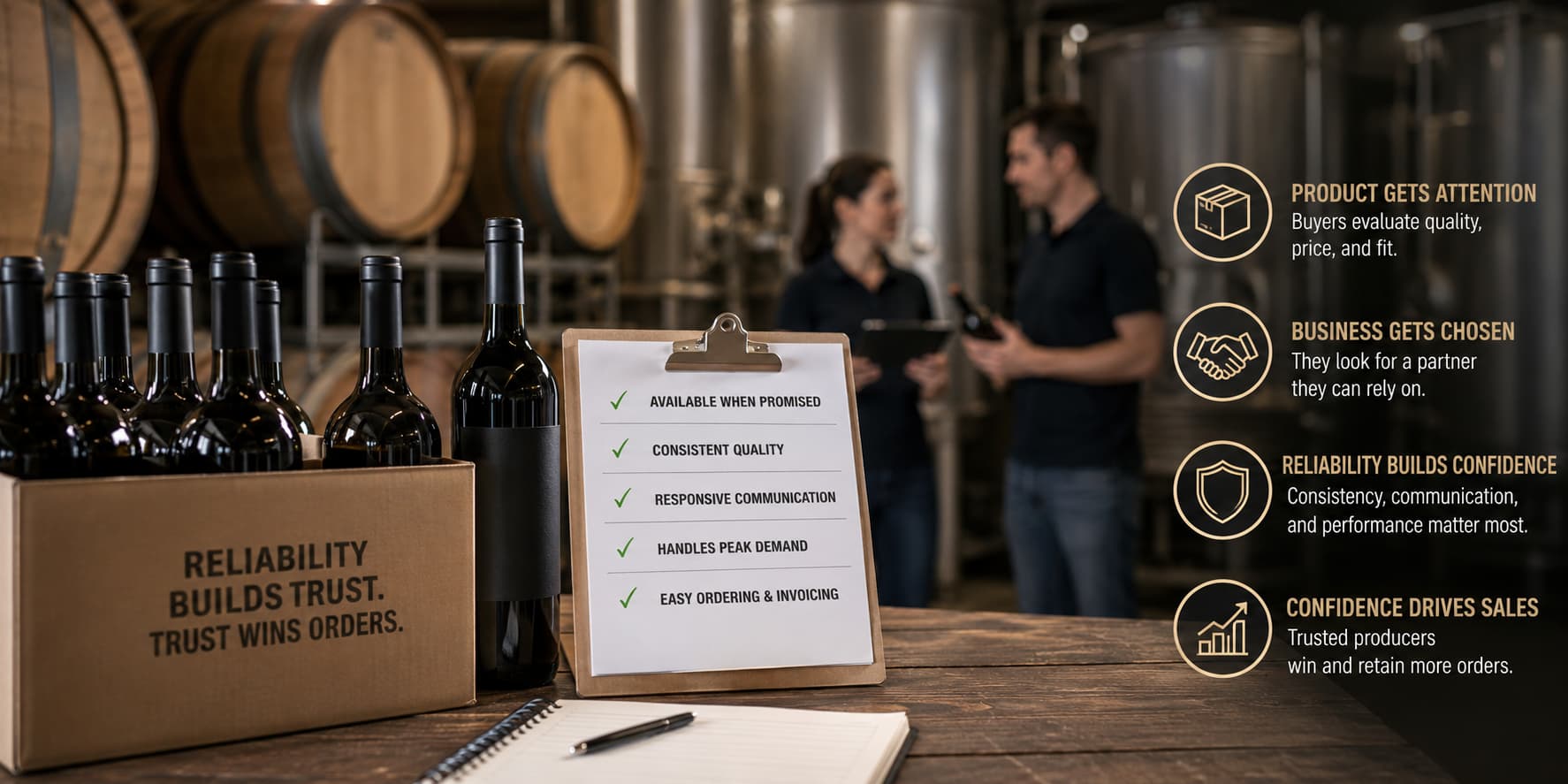
The product gets attention. The business gets chosen.
A retailer, restaurant, distributor, or hospitality group is not simply buying a bottle, a keg, or a case.
They are committing shelf space, cash flow, staff time, and part of their own reputation.
Before changing suppliers, buyers usually ask themselves questions such as:
- Will this product be available when we need it?
- Will the quality remain consistent from batch to batch or vintage to vintage?
- How quickly will they respond if something goes wrong?
- Can they handle increased demand during peak periods?
- Will ordering and invoicing be straightforward?
These questions are often more important than producers expect. A buyer may love the product but still hesitate if they are uncertain about the business behind it.
Why operational reliability matters so much
For wineries, breweries, and distilleries, this is where sales and operations become tightly connected.
A buyer’s confidence is shaped by things that happen long before the next sales meeting.
Production planning
If production is well planned, products are more likely to be available when promised. Nothing damages confidence faster than repeated stock shortages.
Inventory accuracy
When inventory records are reliable, sales teams can give buyers accurate information about availability, allocations, and lead times.
Quality control
Consistency is critical in wholesale markets. Buyers need to know that the wine poured next month, the beer tapped next week, or the spirit delivered to multiple venues will meet the same standard every time.
Forecasting
Better forecasting helps producers prepare for seasonal demand, promotional activity, and distributor requirements instead of reacting at the last minute.
Order fulfillment
Fast, accurate fulfillment reduces friction for the buyer and makes reordering easier.
These are not just operational metrics. They are signals that tell a buyer whether your business is dependable.
Reliability is an underrated competitive advantage
Many producers invest heavily in improving quality, packaging, sustainability, branding, and innovation. All of these can help open doors.
But in wholesale markets, reliability is often what keeps those doors open.
Consider two suppliers:
Supplier A
Excellent product
- Award-winning product
- Strong branding
- Slightly lower price
- Occasional stock shortages
- Slow communication
Supplier B
Reliable partner
- Consistent product
- Clear lead times
- Accurate inventory
- Fast responses
- Reliable delivery
Many buyers will choose Supplier B, even if Supplier A looks better on paper.
Why? Because Supplier B reduces operational stress.
For a restaurant, that means fewer service issues. For a retailer, fewer disappointed customers. For a distributor, fewer emergency phone calls.
What this means for producers
This is not an argument against making exceptional products. Quality remains essential. The lesson is that operational excellence strengthens commercial performance. Producers who consistently win and retain wholesale customers tend to focus on three areas:
- Visibility
Know what is in production, what is in stock, and what can be promised confidently.
- Communication
Provide buyers with clear, accurate, and timely information.
- Consistency
Deliver the same standard of product and service repeatedly, not just occasionally.
These may sound simple, but they are difficult to execute consistently as a business grows.
The hidden link between production and sales
One of the most overlooked truths in the alcohol industry is that production systems influence sales outcomes.
When teams have clear visibility across production, inventory, orders, and fulfillment, they can make better commitments to customers. Buyers receive more accurate information, fewer surprises, and a smoother experience.
In that sense, a well-run operation does more than improve efficiency internally—it helps build trust externally.
In conclusion, wholesale buyers may first notice your wine, beer, or spirits, but they choose the producer they believe can deliver consistently.
Awards, branding, and pricing can create interest. Reliable production, accurate inventory, clear communication, and dependable fulfillment create confidence.
For wineries, breweries, and distilleries, that is the real commercial opportunity.
The strongest wholesale relationships are rarely built on product quality alone. They are built on the confidence that every promise—from production through to delivery—will be kept.