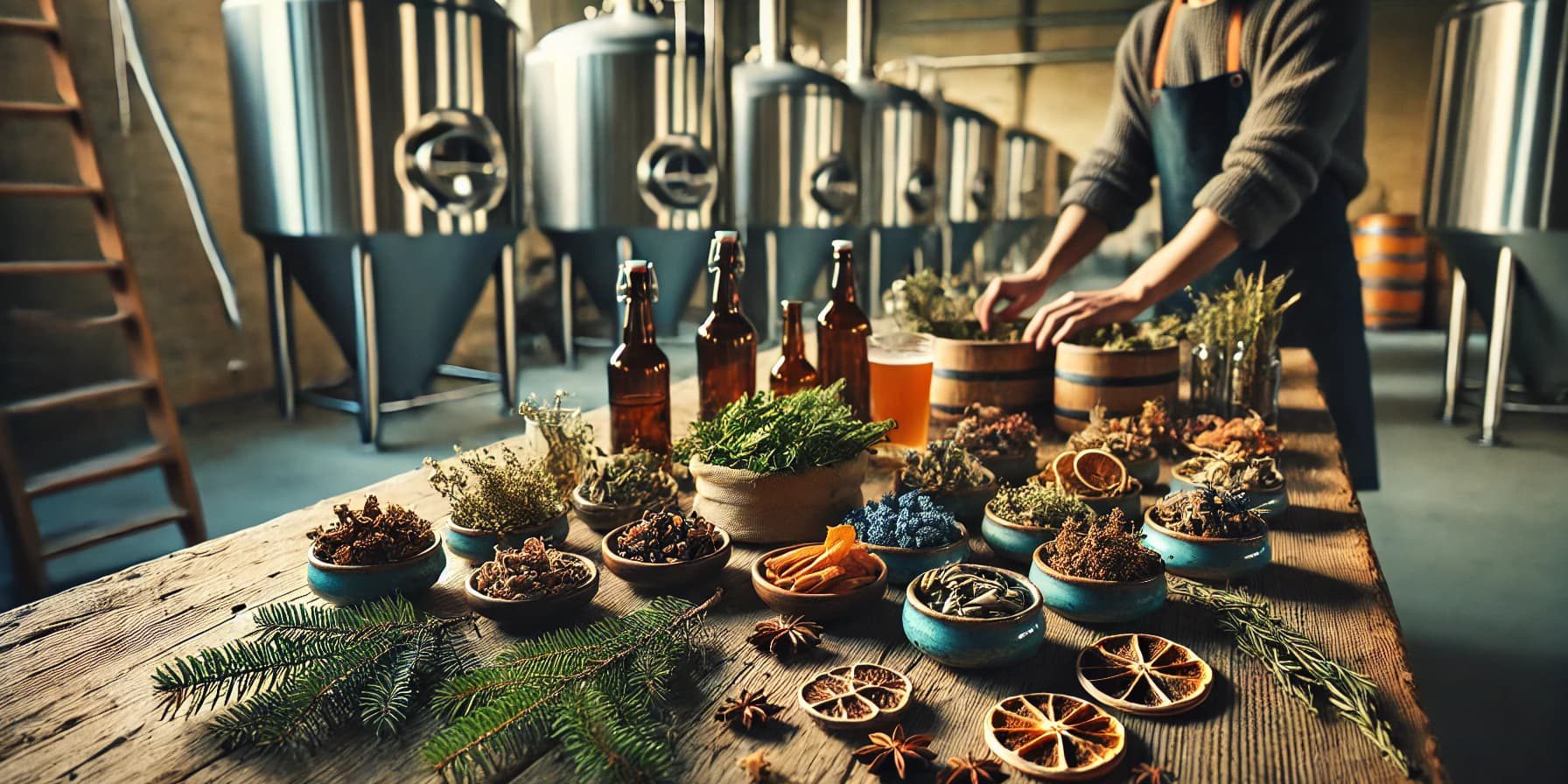
Hop-free beer sounds like a contradiction. For most modern producers, hops define bitterness, aroma, and even shelf stability. But historically, hops were the innovation—not the rule. Today, a small but growing group of brewers are revisiting that idea, using alternative ingredients, fermentation techniques, and new flavour strategies to build beer without relying on hops at all.
At its core, this shift is driven by:
- A desire for differentiation in a crowded market
- Increasing experimentation across the craft segment
- A willingness to challenge what defines “beer”
A Return to (and Reinvention of) Gruit
Before hops became dominant, beer was flavoured with botanical blends known as gruit—combinations of herbs like yarrow, mugwort, and rosemary. What’s happening now isn’t just a revival of tradition, but a reinvention of it. Brewers are using these and other ingredients not to replicate hops exactly, but to create entirely new flavour profiles that still deliver balance and drinkability.
In New Zealand, while fully hop-free commercial examples are still limited, the building blocks are emerging. Suppliers like Kahikatea Farm are cultivating and selling botanicals suited for brewing, distilling, and winemaking—making it easier for producers to experiment with gruit-style formulations using locally grown ingredients.
Alongside ingredient supply, access to flexible small-scale brewing systems is also supporting experimentation. New Zealand companies like Grainfather have made it easier for brewers to trial non-traditional recipes in controlled, repeatable ways—lowering the barrier to developing hop-free or botanical-driven formulations before scaling them commercially.
Common gruit-style components include:
- Herbal bitterness (yarrow, mugwort)
- Aromatic lift (rosemary, lavender)
- Earthy or resinous structure (juniper, spruce)
What Replaces Hops?
Modern hop-free brewing is less about substitution and more about rethinking structure. Brewers still need bitterness to offset malt sweetness and complexity to carry the product. Botanical alternatives—spruce tips, citrus peel, spices, and flowers—are doing much of that work. In many cases, the result sits somewhere between beer, a herbal tonic, and a culinary expression, rather than a direct analogue to a classic lager or IPA.
In practice, that structure is built through:
- Bitterness from herbs, bark, and spices
- Aroma from flowers, citrus, and wild botanicals
- Texture and balance from fermentation and residual sugars
Brewers Leading the Way
A number of producers are already exploring this space in meaningful ways. Scratch Brewing Company is known for foraging local ingredients and producing beers without traditional hops, incorporating elements like cherry bark, wildflowers, and forest botanicals. de Garde Brewing has experimented with flower-driven fermentations—lavender, peach blossom, and other aromatics—to build complexity without relying on hop profiles. Meanwhile, Gentse Gruut Brewery has built its entire identity around hop-free beer, producing multiple styles that replace hops with herbal blends inspired by medieval recipes.
This approach is also emerging closer to home. Bridge Road Brewers released its Mayday Hills Gruit, a barrel-aged beer developed in collaboration with a chef and bitters producer, using botanicals in place of hops.
What these producers have in common:
- A willingness to move beyond traditional style guidelines
- Strong reliance on local or seasonal ingredients
- A focus on flavour design rather than ingredient convention
Beyond Fully Hop-Free
There are also adjacent approaches that achieve similar outcomes. Some beers minimise hops and instead rely on fruit or fermentation-driven acidity for balance. For example, Dogfish Head Craft Brewery’s Festina Pêche uses fruit and souring to create structure, while producers like Lindemans Brewery build flavour primarily through fruit and wild fermentation rather than hop character. In these cases, hops may still be present, but they are no longer the defining feature of the product.
This broader category often leans on:
- Fruit for acidity and balance
- Wild fermentation for complexity
- Low or background hop usage
Fermentation as a Flavour Tool
Another frontier sits in fermentation itself. Yeast selection and biotransformation are increasingly being used to generate hop-like aromatics—citrus, tropical fruit, floral notes—without adding hops directly. This approach is still evolving, but it points toward a future where “hop character” becomes a design outcome rather than something tied to a specific ingredient.
Key levers include:
- Yeast strain selection
- Fermentation temperature control
- Biotransformation during active fermentation
Production Realities
From a production perspective, hop-free brewing introduces both flexibility and complexity. Recipes become less standardised, often relying on seasonal or locally sourced botanicals. Extraction timing, dosage, and stability behave differently compared to hops. Consistency becomes harder to maintain, particularly at scale, even as reliance on volatile hop markets is reduced.
Operational challenges typically include:
- Variability in raw botanical inputs
- Less predictable extraction outcomes
- Greater sensitivity to process changes
The Role of Data and Visibility
This is where operational visibility becomes critical. When you’re no longer working with a highly standardised input like hops, tracking how each ingredient performs—across cost, yield, and flavour impact—becomes essential. Small variations in botanical blends or fermentation behaviour can significantly shift the final product. Without clear oversight, experimentation can quickly turn into inconsistency.
In practical terms, producers need to understand:
- How each ingredient impacts final flavour
- True cost contribution of non-standard inputs
- Batch-to-batch variation and its causes
A Different Kind of Opportunity
Commercially, hop-free beers are not trying to compete directly with traditional styles. Instead, they offer differentiation. They appeal to drinkers looking for something new—whether that’s lower bitterness, unique flavour profiles, or a different kind of drinking experience. They also align naturally with broader trends around low- and no-alcohol beverages, sustainability, and experimentation.
This includes:
- Growth in low- and no-alcohol categories
- Increased interest in sustainability and local sourcing
- Consumer openness to hybrid or cross-category products
Expanding the Definition of Beer
Hop-free innovation isn’t about replacing hops. It’s about removing a constraint. When brewers are no longer anchored to a single ingredient for bitterness and aroma, the definition of beer starts to expand. And in a category where standing out is increasingly difficult, that shift may be where the real opportunity lies.