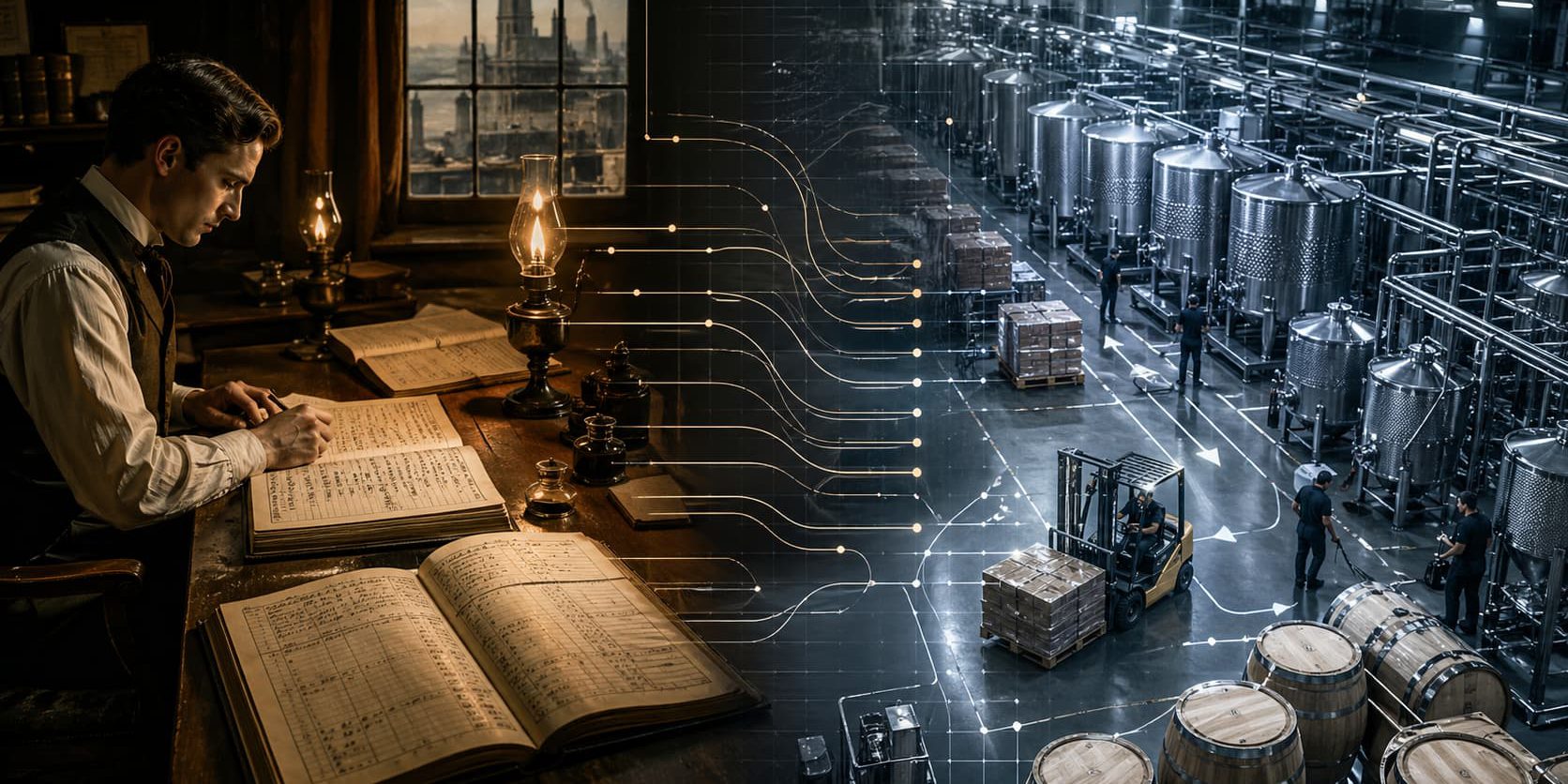
John D. Rockefeller was sixteen when he first stepped into a job that would quietly shape the way he saw the world. An assistant bookkeeper in a small office in Cleveland.
It was not the kind of work that carried status or excitement. It was careful, repetitive work—recording numbers, tracking payments, making sure the books balanced at the end of each day. The sort of role most people would pass through without thinking too much about what it meant beyond the task in front of them.
But for a teenage boy like John D. Rockefeller, it became something different. It became a way of understanding how business actually worked.
Day after day, he sat with the numbers and began to notice things that didn’t appear in any formal lesson. How money moved in patterns. How costs seemed to reappear in different places under different names. How small variations in pricing, timing, or handling quietly shaped the final outcome of a transaction.
Nothing dramatic on its own. Nothing that would stand out in isolation. But over time, something began to form in the way he was thinking. He stopped seeing the job as just recording what had already happened and started seeing it as a window into how the entire system functioned.
As he moved into the oil industry in his late teens and early twenties, that way of thinking came with him. The industry itself, at the time, was still young and uneven. It didn’t operate with the kind of structure or efficiency that would come later. It was fragmented, full of variation, and often driven by whoever happened to control a small piece of the chain at any given point.
- How oil moved from extraction to refining.
- How it was stored, transported, and sold.
- How each stage influenced the next, often in ways that weren’t immediately visible unless you stepped back and looked at the whole picture.
Over time, he stopped thinking in terms of separate activities and started seeing a single system. John noticed the small differences that everyone else accepted as the norm. Not because they are large, but because they repeat. And when something repeats across a system, it starts to matter more than it appears to at first glance.
This is where one of the most commonly retold parts of his story comes from. The idea that small differences in transport costs—just a few cents per barrel in some cases—became significant when scaled across volume. That freight rates, negotiations, and routing decisions quietly accumulated into something much larger than they appeared on paper.
By his early twenties, he had already begun moving into partnerships and building a more active role in shaping how businesses in the industry operated. And in 1870 he helped to establish the Standard Oil Company based on operational structure.
What followed is well documented. The scale, the consolidation, the dominance that emerged over time as the business grew into one of the most powerful industrial organisations of its era.
He would go on to become one of the wealthiest Americans of all time and one of the richest people in modern history.
Translation — What Operations Really Is
This is where the lesson becomes modern.
What Rockefeller did instinctively—by understanding how every part of the system connected—is what we now describe as operations.
Not administration
Operations is not paperwork, reporting, or managing tasks for the sake of control.
It is understanding how value moves
It is the ability to see how value is created in a business, how it moves from one stage to the next, and where it is quietly gained or lost along the way.
Where small decisions matter at scale
It is also understanding that small operational decisions are rarely small in impact when repeated across volume, time, or production cycles.
A system, not a snapshot
Operations is not a collection of isolated activities. It is the full map of how a business actually works in reality—not in theory. And most businesses don’t operate with a complete map. They operate with fragments of one.
Application — The Same Blind Spots Still Exist Today
In alcohol production, the system is more complex, but the structure is the same. Products move through multiple stages—production, storage, packaging, distribution—and at each point, small decisions are made that influence the final outcome.
Production is a system of connected decisions
How a product moves through production, storage, and packaging is not separate steps—it is one continuous flow where each stage affects the next.
Small decisions shape big outcomes
- How efficiently product moves through production
- How accurately inventory reflects reality
- How well production aligns with demand
- How much is lost through timing or planning gaps
Individually, these seem minor, but together, they shape the performance of an entire season.
At scale, small inefficiencies compound
This is where the comparison to Rockefeller becomes clear. Small inefficiencies do not stay small when repeated across volume. They accumulate into structural differences in cost, margin, and availability.
The real challenge is visibility
The issue is rarely effort or capability – It is visibility. Because when you cannot clearly see how the system is behaving, you cannot fully understand the impact of each decision inside it. And if you cannot see the system clearly, you cannot improve it consistently.
In conclusion, that is really what separates businesses over time.
Not the size of the decisions they make, but how clearly they understand the system those decisions sit inside. Because once you can see the full picture, even the smallest operational detail starts to matter in a way it didn’t before—and that is where control, consistency, and long-term advantage actually come from.